
Train driver & occupant monitoring AI on synthetic cabin data.
OpenCabin Studio delivers diverse, controllable, privacy-safe in-cabin simulation data, accelerating driver and in-vehicle occupant monitoring AI for the smart interior — without the limits of real-world data collection.
PLATFORM_RENDER_3D
The problem
- Real-world data collection is expensive and slow, locked behind complex vehicle, sensor, and participant setups.
- Manual annotation demands domain expertise, ties up heavy resources, and stalls delivery timelines.
- Coverage stays narrow and unbalanced. Rare, dangerous, or edge-case scenarios are nearly impossible to capture.
- Biometric and facial data trigger serious GDPR and privacy compliance risks.
- Demographic, vehicle interior, and behavior diversity remains hard and costly to achieve with real data.
Our approach
- Synthetic data generated at scale by OpenCabin Studio, with GPU parallel rendering and automatic animation across avatars and cabin layouts.
- Automatic annotation pipeline covering 2D/3D keypoints, bounding boxes, segmentation, gaze and head pose, exported in standard dataset formats.
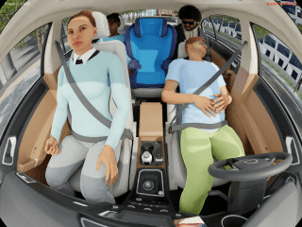
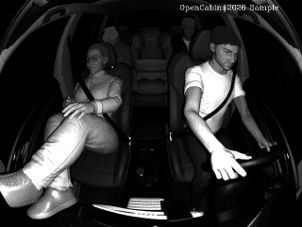
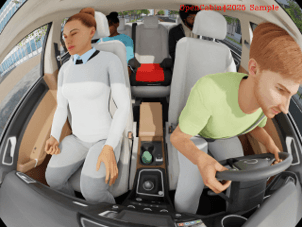
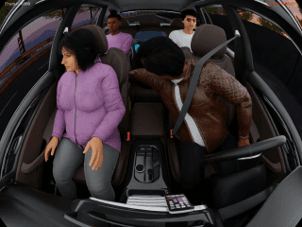
- Unlimited scene variations including safety-critical edge cases (reclined posture, feet on dashboard, reaching to rear seats).
- Fully synthetic avatars, no real faces, no biometric data, no consent management required.
- Parametric avatars across ethnicities, ages, body types, and clothing, paired with multiple car interiors and sensor configurations.
What we deliver
From raw sensor frames to training-ready annotations.
Standard annotations, edge cases, multi-sensor configurations, and custom outputs — all generated by OpenCabin Studio, delivered in the formats your pipeline expects.
01Overview
One scene. Multiple modalities. Every annotation.
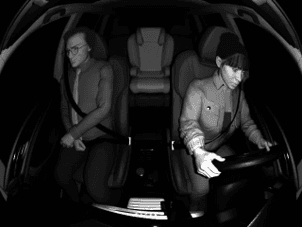
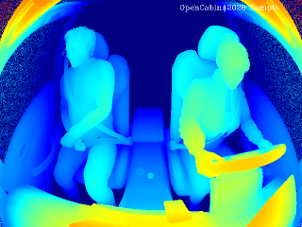
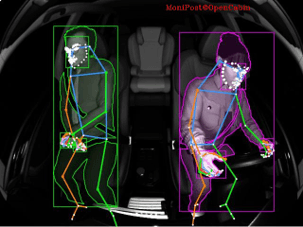
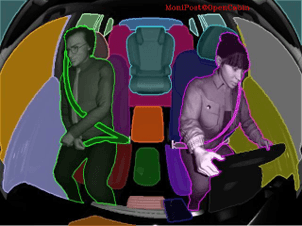
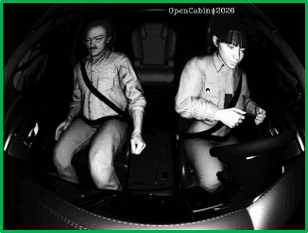
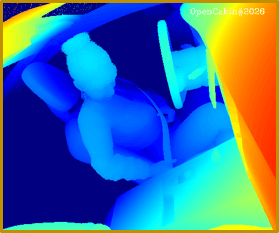
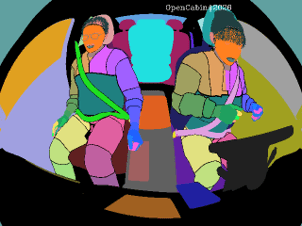
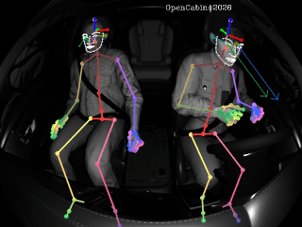
For each scene, OpenCabin Studio renders multiple sensor modalities (RGB, NIR, depth) and exports the standard annotations — bounding boxes, keypoints, instance segmentation — all pixel-aligned.
02Edge cases
The critical cases real-world collection can't reach.
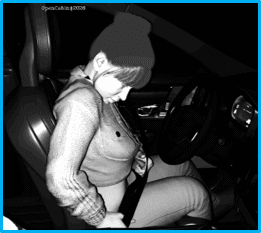
Reclined posture, feet on the dashboard, reaching to rear seats, occupant very close to interior components. OpenCabin Studio generates these rare scenarios at scale — no vehicle, no participants, no risk.
03In-cabin simulation
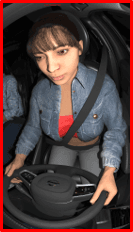
RGB, NIR, depth — fisheye or pin-hole, anywhere you place them.
Position, orientation, FOV, resolution, FPS, distortion: every parameter is adjustable. Single camera or synchronized multi-sensor rig, OpenCabin Studio mirrors your production setup.
04Customizable annotations
Beyond standard annotations.
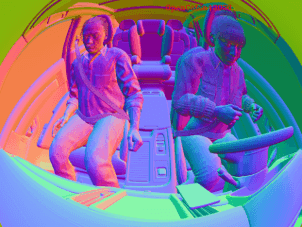
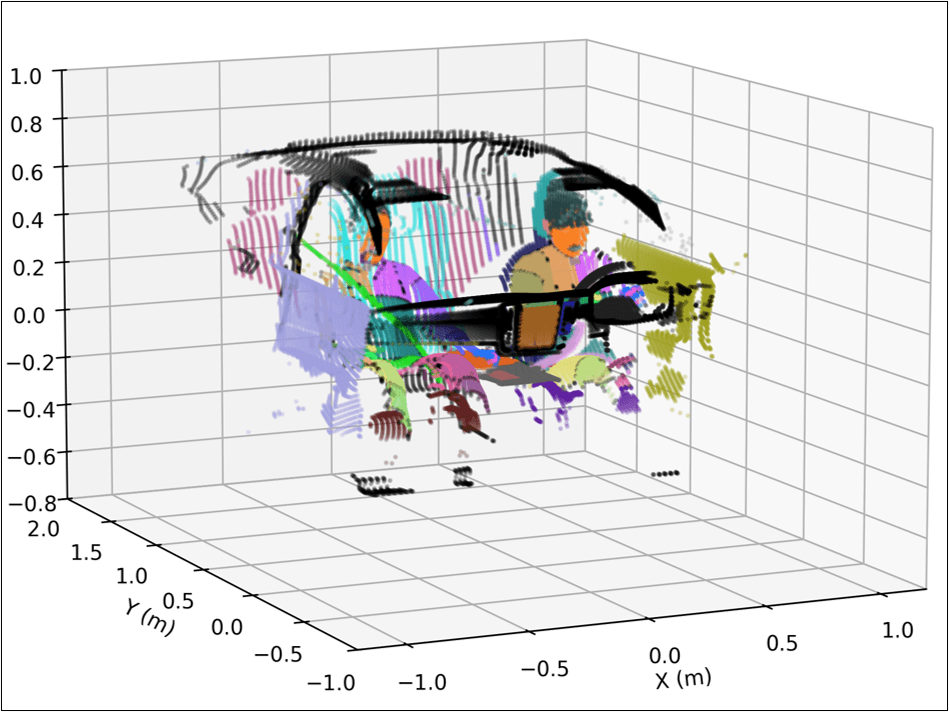
Custom keypoints, detailed body segmentations, surface normal maps, segmented point clouds. When your pipeline needs an output beyond the standard schemas, OpenCabin Studio generates it on demand.
Smart-interior applications
In-cabin perception, with no blind spots.
Eleven modules to train driver monitoring, occupant monitoring and in-cabin perception AI on OpenCabin Studio's annotated synthetic data.
Facial expression analysis
User identification
Occupant state detection
2D / 3D posture detection
Body posture reconstruction
Activity detection
Gesture recognition
Seatbelt usage detection
Hand object detection
Child seat detection
In-cabin motion capture systems
More on the way
Demos
From animation engine to deployed models.
See OpenCabin Studio in action: how we generate, scale, and validate synthetic in-cabin data end to end.
01Posture adaptation
One animation. Infinite variations.
OpenCabin Studio's animation engine retargets a single reference posture across body shapes, demographics, and cabin geometries. Physical constraints respected, every frame.
02Sim-to-real transfer
Trained on synthetic. Validated on reality.
Deep learning models trained exclusively on OpenCabin Studio synthetic data, then tested on real-world footage. No markers, no rigs, just 2D camera input.
- Markerless full-body pose reconstruction from 2D real-time inputs, under kinematic constraints.
- Real captures feed back into the animation library, fueling richer synthetic generation.
- A virtuous cycle: better real-world capture, richer animations, higher-quality data, better models.
FAQ
Common questions from research teams.
About MoniPost
MoniPost is a DeepTech startup spun out of Université Gustave Eiffel in March 2025, backed by Bpifrance. We build synthetic data infrastructure that helps automotive suppliers and OEMs develop safer, smarter in-cabin AI, faster and without the limitations of real-world data collection. We also develop ready-to-use applications that leverage our datasets to help researchers gain deeper insights into driver behavior and in-vehicle activities.
Developing high-performing In-Cabin Monitoring Systems (IMS) requires large, diverse, and accurately labeled datasets. Real-world data collection is expensive, slow, privacy-sensitive, and impossible to scale. MoniPost eliminates these bottlenecks by providing synthetic data that is photorealistic, fully annotated, privacy-compliant, and generated at scale on demand.
MoniPost was founded in partnership with Université Gustave Eiffel and is supported by Bpifrance as part of its DeepTech program. These partnerships ground our work in rigorous academic research while accelerating our path to market.
The smart interior relies on perception models — driver monitoring, occupant monitoring, gesture and activity recognition — that need vast, balanced, privacy-safe data. MoniPost's synthetic datasets and in-cabin simulation let OEMs and Tier-1s train these smart interior systems faster, covering rare scenarios real-world collection can't reach.
OpenCabin Studio
OpenCabin Studio is our end-to-end synthetic data platform for in-cabin vision AI. It covers the full pipeline: 3D asset creation (avatars, vehicles, environments), animation, multi-sensor simulation, physically based rendering, automatic annotation, and structured dataset export, all in one integrated workflow.
We support RGB, NIR (Near-Infrared), TOF depth, and RGBD cameras, with both pin-hole and fisheye lens models. Camera positions, intrinsics, resolution, FPS, and distortion parameters are fully configurable, and synchronized multi-sensor setups are supported out of the box.
Yes, this is one of our core strengths. We can precisely simulate edge cases that are nearly impossible to capture in real life, such as a driver's body very close to interior components, reclined positions, passengers with feet on the dashboard, or a driver reaching into the rear seats. AI models fail on what they have not seen, we make sure they have seen it all.
In-cabin simulation is the synthetic recreation of a vehicle cabin — occupants, sensors, lighting, and motion — to generate training data without real-world capture. OpenCabin Studio simulates RGB, NIR, and depth sensors in any cabin layout, so you can build driver and occupant monitoring datasets on demand.
Data, annotations & compliance
Our automatic annotation pipeline produces 2D/3D keypoints, bounding boxes, instance segmentation, depth maps, surface normals, gaze direction, head orientation, and body pose. Outputs are available in COCO, KITTI, H36M, SMPL/SMPL-X, Drive&Act, and custom schemas, structured and export-ready for immediate use in training and validation workflows.
Fully. All data is synthetically generated, no real faces, no biometric information, no consent or data retention issues. OpenCabin data is inherently GDPR-compliant and safe for use across all markets and regulatory environments.
Our primary customers are automotive OEMs and Tier-1 suppliers developing Driver Monitoring Systems (DMS) and Occupant Monitoring Systems (OMS). We also serve academic researchers and AI teams working on in-cabin perception, human pose estimation, and vehicle safety systems.
Reach out to us at contact@monipost.com. We will discuss your use case, sensor setup, annotation requirements, and data volume needs, and design a dataset generation plan tailored to your project.